Article
IntuigenceAI: Giving Operators and Engineers Their Time Back, Meet the Intuigents

Scroll
Hasma Habibiy
August 1, 2026
Overview
IntuigenceAI provides AI synthetic engineers for industrial operations that turn plant questions into reviewable engineering outputs. They pull evidence from your plant's documents, P&IDs, and historian time-series, then return answers with typed citations you can click back to the exact PDF page, diagram entity, or tag and time range.
AI Synthetic Engineers for Industrial Ops
1. Introduction
If you are grinding through another challenging day or night in a refinery, chemical plant, or gas processing facility, you already know the drill. Pulling data from the historian, digging through P&IDs and procedures buried in SharePoint or dusty binders, scribbling shift handover notes, chasing down MOC paperwork, updating SOPs that nobody has touched in years, and trying to make sense of alarm floods while keeping the unit stable. It is high-volume work that keeps the plant running; but it burns the time you actually need for the stuff that moves the needle, diagnosing an upset, squeezing out another percent of throughput, spotting a reliability issue before it becomes a shutdown, or safely navigating a complex startup.
That is exactly why we built Intuigents at IntuigenceAI. When you think about Intuigents, do not picture a chatbot tab. Picture a plant support teammate that never sleeps. Intuigents are AI synthetic engineers, virtual and delegatable teammates that live inside your workflows 24/7. They take on the routine evidence stitching and documentation grind so you can focus on the work that requires engineering rigor, interpreting the data, validating constraints, and making defensible recommendations. The outputs are reviewable engineering work products, with citations back to the source and assumptions stated clearly, so decisions can be checked, reproduced, and defended later.
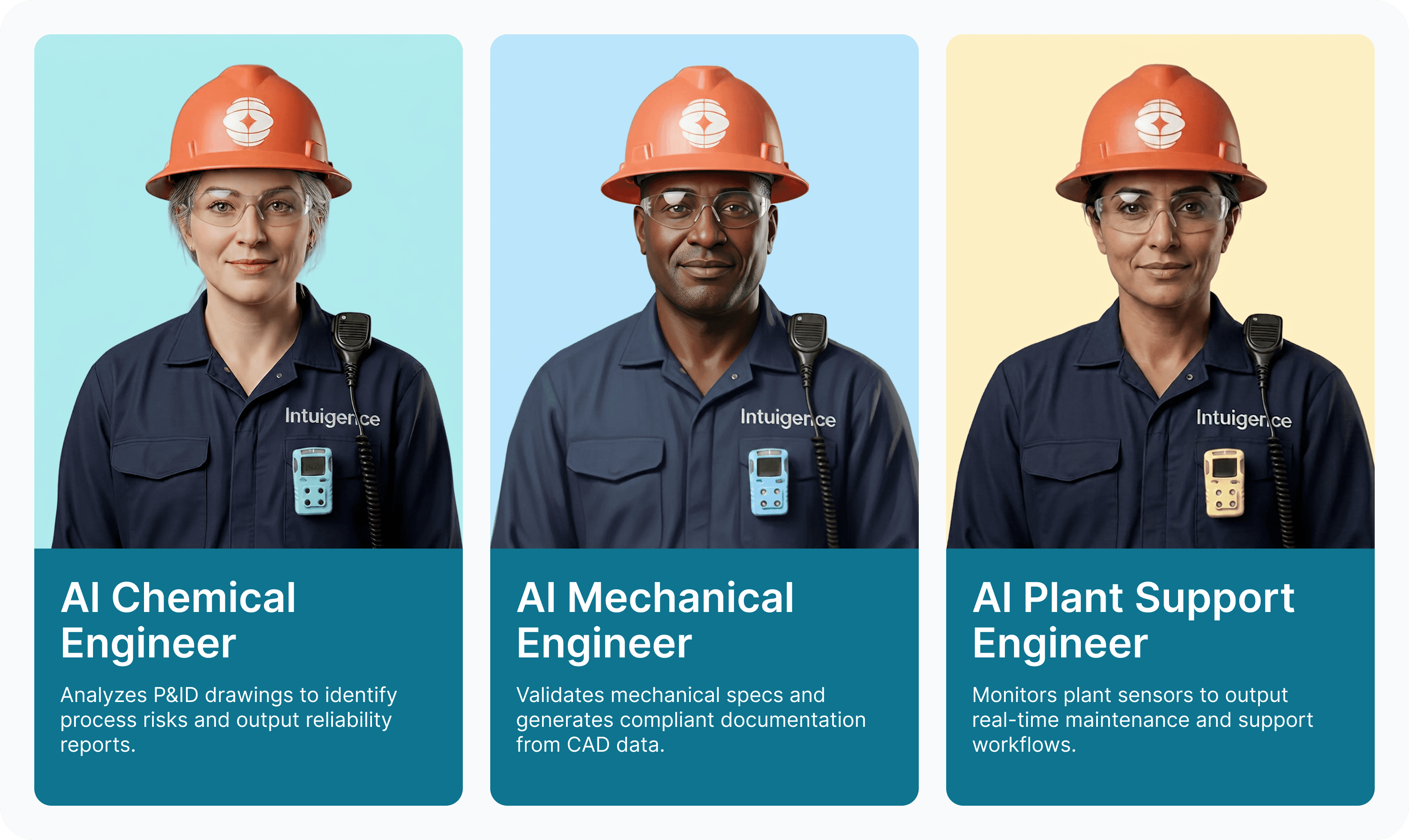
Meet the Intuigents:
2. What is an AI Synthetic Engineer, and what can it do for your team?
An AI synthetic engineer is an engineer-role agent (Chemical, Mechanical, Electrical, and Plant Support) trained to work like a real engineer in industrial environments.
A useful mental model is “one agent, multiple hats”, one core system that stays consistent in how it pulls plant artifacts and uses tools, but can switch into a Chemical vs Mechanical vs Electrical mode depending on the job, changing what it prioritizes, what it checks, and how it frames the output. The intent is simple: it should feel like an always-available engineering coworker, fast, scalable, and always on so the work doesn’t stall at shift change, quitting time, inbox load, or “wait until the expert is free.”
Here’s what an Intuigent can do for your team right now
A. Document parsing and retrieval: pull the right answer out of plant documents, with references to source documents.
When someone asks a design or procedure question, the slow part is often not the technical evaluation of the related information and the crafting of a response. Instead, it is finding the clause, table, or note you trust, confirming the revision, and writing it down in a way someone else can verify. An Intuigent enables indexing and retrieval from manuals, SOPs, and technical documentation to generate structured, reviewable engineering artifacts that teams normally create by hand.
B. Engineering diagram + graph tooling: answer P&ID questions like an engineer, not like a keyword search
A lot of arguments in plants are not about theory. They are about what is connected, where the isolation points are, and what got missed when the line jumped sheets or the drawing revision changed. An Intuigent supports and works with technical drawings/diagrams and represents relationships as graphs (useful for navigating plant structure and context).
C. Time-series connectivity + analysis: compare historian trends to documented limits, with units stated upfront
Most operational work involves comparing current trends to constraints, past performance, or a good baseline. Troubleshooting often starts by asking, "What's different now?". The trend is easy to pull. The limit is usually in a different place, written in a different unit system, and referenced differently than the tag name in the historian. An Intuigent can pull live and historical plant signals via historian integrations (e.g., OSIsoft PI), then analyze windows and trends to support decisions.
D. Workflow decomposition + execution: turn messy multi-source questions into one reviewable work product
The questions that slow teams down are rarely single artifact questions. They are “what does the vendor manual say, what does the P&ID show, and what does the procedure actually instruct?” An Intuigent breaks a task into specialist steps, applies site-configured canonical-source rules, and normalizes tags, P&ID entities, and units so evidence can be joined reliably. When duplicates or revisions conflict, it surfaces diffs, flags low-confidence items, and routes them to named owners for quick resolution, and every decision and edit carries provenance so the final output is auditable.
E. The Video Call Agent: capture troubleshooting calls and turn them into decisions, plans, and actions
If the real explanation only exists in a call, it is one shift away from becoming tribal knowledge. The video call agent is for keeping that context from evaporating and turning it into something the next shift can use. An Intuigent will bring the same evidence-backed assistance into live conversations (e.g., Google Meets) so analysis doesn’t rely on memory alone.
One note on competence, because it matters. Intuigents are grounded in PhD-level domain knowledge by discipline, and we treat correctness like an engineering requirement, with discipline-specific training examples and evaluation suites aimed at accuracy and traceability, not just fluent writing.
3. What makes the outputs trustworthy?
Everything above works only if the system can show its work. Intuigents are designed to behave like a careful engineer on a good day.
• Evidence-backed answers that cite the exact source location in documents, P&IDs, and historian outputs
• Cross-referencing across data and information sources, not just single document searching
• Assumptions stated clearly, especially units, revisions, and tag mappings
• Stop and ask behavior when the inputs are ambiguous, rather than guessing
4. How to get value fast
Start with one unit and one document set. Pick a narrow slice and the artifacts you already use, then prove you can get repeatable answers and work products before you expand.
Make “where is this stated?” non-negotiable. If the system can’t cite evidence, treat the output as a hypothesis, not a fact.
Use a shared workspace. Adoption moves faster when reliability, ops, and planning share the same evidence trail and can reproduce each other’s work without re-litigating context.
Button: Try Intuigents on one unit
Subtext: Prove value with your own P&IDs, SOPs, and a week of historian data.
5. P.S.
Want to test this on your site? Start with one unit, one document set, and a week of historian data. Run your real troubleshooting and planning questions through IntuigenceAI. The output should be reviewable, grounded in evidence, explicit about assumptions, and easy to share across the team.
Button: See Intuigents at work
FAQ
Q: How do Intuigents protect plant safety?
A: Industrial environments demand reliability and human oversight. Our platform is designed to assist operators while keeping people in control of decisions that affect plant operations. When the system encounters uncertainty or conflicting inputs, it flags the issue and routes it for human review, ensuring accountability and traceability.
Q: How secure is my data and how do you deploy?
A: Security is built into the platform from the beginning. IntuigenceAI follows modern security practices to protect customer environments and data, including strong access controls, secure system architecture, and continuous monitoring of system activity.
We design our systems so organizations maintain visibility and control over how the technology interacts with their operations. IntuigenceAI has completed a SOC 2 Type I independent audit, demonstrating that our security controls and operational practices have been evaluated against industry standards.
Q: How do you handle privacy and data retention?
A: We are transparent about how information is handled.
We only collect the information necessary to operate and improve the service, such as account information, user-provided inputs, and limited system usage data needed for reliability and security.
We do not sell personal data or use customer data for advertising. Data is retained only as long as necessary to deliver the service or meet security and legal obligations.
Q: What is an AI synthetic and how does it help industrial operations?
A: It’s a synthetic software agent trained to work like a real engineer in an industrial operating environment. It helps by automating routine tasks, assisting with analysis, generating documentation, and improving over time, so teams save time, reduce human error, and move faster on decisions.
Q: How is IntuigenceAI different from traditional automation or analytics tools?
A: Traditional tools mostly show you data. IntuigenceAI agents are built to plan, execute, and validate workflows, not just display dashboards. They can operate across connected systems (the site calls out SAP, OSIsoft PI, and Excel) and are designed for high-context engineering work where the “why” and the surrounding evidence matter.
Q: Can I train the AI synthetic engineers on our own internal processes?
A: Yes. The intended approach is to absorb your plant’s knowledge through your documents and SOPs, plus expert input (the site mentions expert interviews) and past execution data. You can also customize roles around what you actually need, like a maintenance-focused agent or a process-safety-focused agent.
Q: How quickly can I get started with IntuigenceAI?
A: The public claim is “days, not months.” The agents are described as pre-trained for core manufacturing workflows and onboarded through a guided workspace so they fit into your existing stack quickly. Sign up today button
Q: Where does an AI synthetic engineer fit in a real plant workflow
A: It fits in the gaps where engineers and supervisors burn time stitching context together. During troubleshooting, it helps pull the right excerpts, trends, and diagram context fast. During planning, it helps build a first pass job package and isolation notes. During MOC and audit prep, it helps assemble the evidence trail that shows what changed, what was consulted, and what was approved.
Q: What is the difference between an AI synthetic engineer and a digital twin
A: A digital twin is a model of an asset or process,it may be first-principles (simulation), data-driven, or a hybrid, used to predict behavior under defined inputs and assumptions. An AI synthetic engineer is a workflow assistant that uses your existing evidence sources (documents, P&IDs, historian data, meeting notes) to answer questions, reconcile conflicting sources, and draft reviewable work product with traceable citations. They complement each other: a twin can provide model predictions the synthetic engineer cites and tests, while the synthetic engineer provides the evidence trail, operational context, and human-readable outputs that make model outputs actionable.
Q: What kinds of documents and diagrams does it handle well
A: It can ingest a wide range of industrial artifacts: SOPs and procedures, vendor manuals and datasheets, operating envelopes, inspection and reliability reports, maintenance notes/work orders, MOC packages, and P&IDs.
The practical advice is still to start with the highest-leverage set (the documents people reach for under time pressure) so you get value fast, then expand coverage across the rest of your document library once the core workflows are working.